
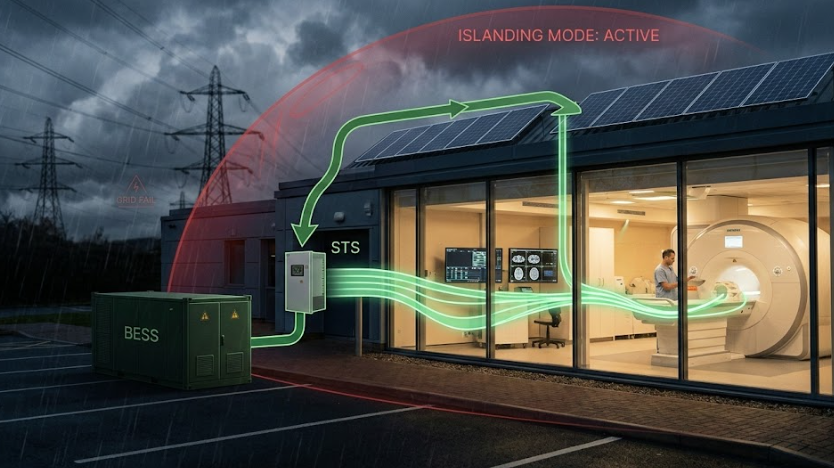
For those managing healthcare estates or high-end commercial data centers, the stability of the public utility grid is a constant variable. As the UK’s energy infrastructure ages, “voltage dips” and supply fluctuations have become significant risks to sensitive equipment.
To mitigate these risks, many facilities are transitioning toward Microgrids. This educational overview explains the mechanics of “Islanding” and the hardware required to maintain 24/7 operations.
What is a Microgrid?
A Microgrid is a localised group of electricity sources that normally operates while connected to the traditional centralised grid. However, its true value lies in its ability to disconnect and function autonomously. This autonomous state is known as “Islanding.”
The Critical Transition: Grid-Connected vs. Islanded
The most technically demanding moment for any facility is the transition between these two modes. For a hospital, even a millisecond of “dirty power” can cause a reboot or damage to high-value medical imaging equipment like MRI or CT scanners.
To manage this transition safely, two key components are required:
1. Battery Energy Storage Systems (BESS)
BESS units act as the immediate buffer. When the main grid fails or fluctuates, the battery system provides the necessary current to maintain the facility’s “base load.” This prevents the “voltage dip” that usually occurs before a backup generator can sync to the load.
2. Static Transfer Switches (STS)
An STS is a high-speed electronic device that can transfer power sources in less than a quarter of a cycle (typically under 5 milliseconds). This is significantly faster than a mechanical switch. In critical environments, this speed is the difference between a seamless transition and a total system crash.
Operational Resilience in the UK
As facilities integrate more sustainable technology, such as LED lighting to reduce base load or EV charging hubs, the complexity of the internal grid grows.
Managing these systems requires a deep understanding of compliance and safety standards, particularly within sectors governed by HTM (Hospital Technical Memoranda). Maintaining a “Gold Standard” in professional vetting, such as NICEIC, Constructionline Gold, and CHAS, ensures that the physical installation of these complex systems meets the UK’s rigorous safety requirements.
The Value of “Islanding”
When a facility is capable of “islanding,” it gains two major advantages:
-
Protection from Grid Instability: Sensitive electronics are shielded from external surges and sags.
-
Energy Autonomy: During peak demand on the national grid, an estate can theoretically run on its own stored power, reducing strain on the wider community.
Technical Summary for Estates Teams
| Component | Function in a Microgrid |
| Microgrid | A localised power network that can run independently. |
| Islanding | The process of disconnecting from the utility grid during a failure. |
| BESS | Batteries that provide immediate power to prevent “voltage dips.” |
| STS | High-speed switches that transition power sources in milliseconds. |